
How robotics is redefining care – and what we can realistically expect over the next five years
For a long time, the promises of robotics were clear and bold: humanoid helpers who care, comfort, lift, and listen. In 2026, a more sober – but far more effective – picture has emerged. The real breakthrough is not the replacement of human care, but its relief. Robots are taking over paths, routines, and physically repetitive tasks, thereby creating space for what cannot be delegated: closeness, judgment, and responsibility.
1. Where we stand today: relief instead of replacement
The most visible progress is currently taking place in hospitals. Assistive robots such as Moxi handle logistics tasks: transporting medications, samples, or consumables. According to the operator, hundreds of thousands of such errands have already been automated in U.S. hospitals¹. Nursing staff report that this measurably increases the time available for patients².
At the same time, the development of humanoid platforms outside the care sector is accelerating. Automotive manufacturers such as BMW are testing humanoid robots in production³. These deployments are not care projects – but they matter because they drive the development of robust hardware, improved gripping systems, and safer human–robot interaction. Precisely these technologies will later become relevant in sensitive fields such as care and support.
2. Rehabilitation and assistance: robotics with evidence
Rehabilitation robotics is closest to clear regulation. Exoskeletons such as EksoNR are approved for specific neurological indications and are used in rehabilitation centers⁴. Studies show improvements in gait, endurance, and therapy intensity. What matters here is not the robot’s autonomy, but precise repeatability under professional supervision.
In everyday life, smaller, highly specialized systems often have a more lasting impact. The feeding robot Obi enables people with motor impairments to eat independently⁵. This is not spectacular AI, but applied robotics with an immediate gain in dignity. Exactly this class – functional, limited, reliable – is considered particularly scalable by experts.
3. Social robotics: loneliness, children, dementia
Social robots are increasingly understood as care interfaces. Systems such as ElliQ combine speech, gestures, and routines to activate older adults and connect them with relatives. A scientific review shows that users primarily value regularity and reliability, rather than the “personality” of the system⁶. Public programs, such as those in New York State, are testing such deployments at scale⁷.
At the same time, responsibility grows. Companion robots collect sensitive behavioral data and create emotional bonds. The therapeutic robot PARO – an interactive robotic seal – has been used in dementia care for years. Studies report reduced agitation and improved mood⁸. Critics, however, point out that closeness without reciprocity can be ethically problematic⁹.
With children, this tension has become particularly evident. The companion robot Moxie lost its functionality after the manufacturer filed for insolvency and shut down cloud services¹⁰. Media reports describe how children had to say goodbye to their “friend”¹¹. The case is now considered a lesson in product responsibility: care technology must not have an expiration date.
In therapeutic contexts – such as autism interventions – robotics remains valuable, but clearly limited. Studies on platforms like NAO or KASPAR show that robots can function as structured interaction partners, not as substitutes for relationships¹².
4. Caring for animals and vulnerable groups: infrastructure instead of imitation
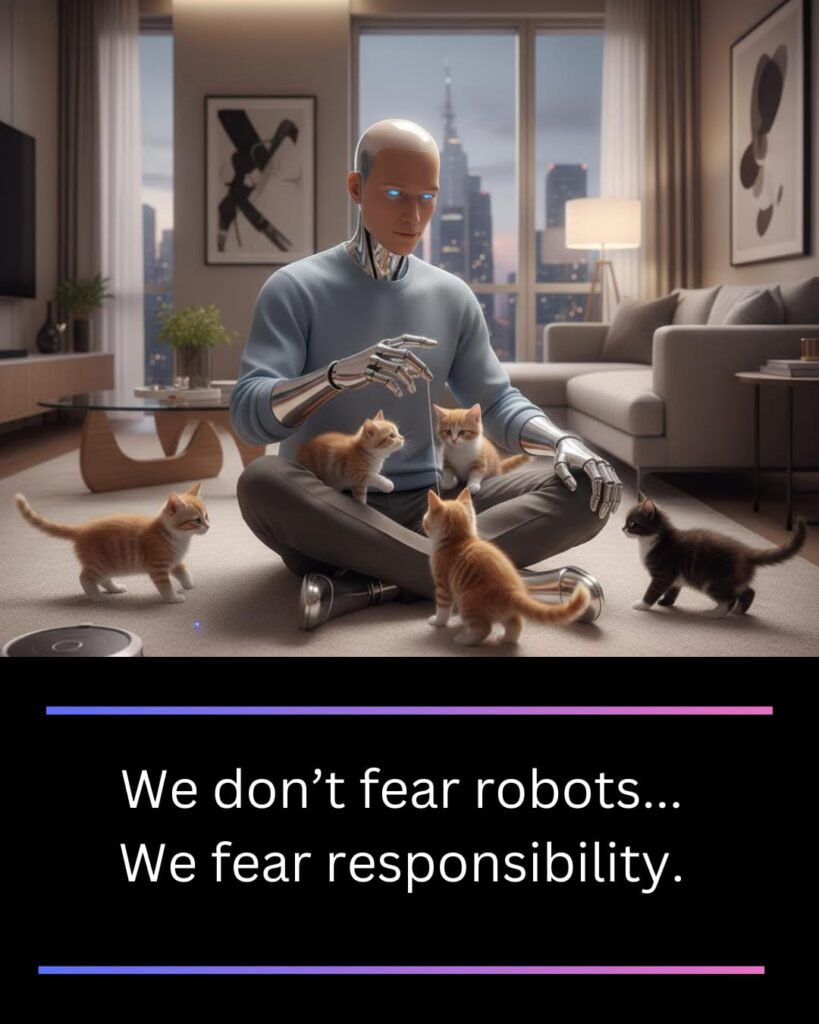
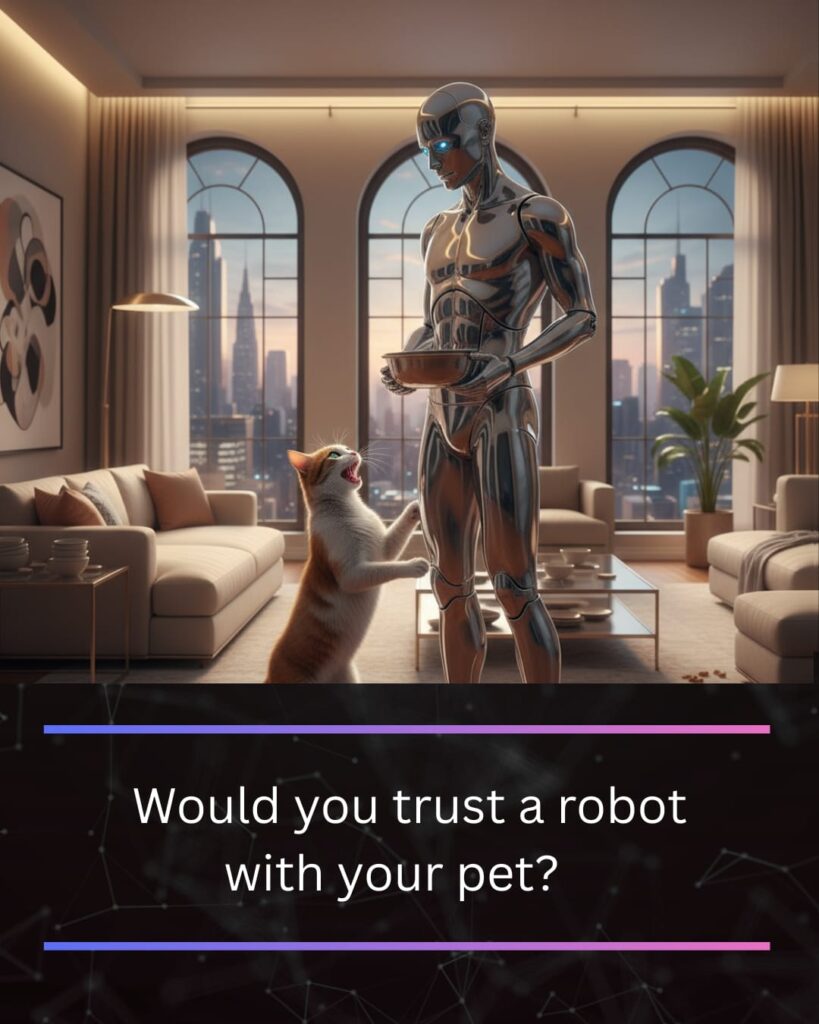
In animal care, a pragmatic trend is emerging. Instead of “robot pets,” systems prevail that enable monitoring, feeding, and tele-veterinary connections. The value lies in early problem detection, not emotional simulation. The same applies to people in need of care: fall detection, medication reminders, and activity analysis often have a greater impact than humanoid presence.
5. Safety, liability, and standards
Care and assistive robots interact with vulnerable groups and therefore face special requirements. The international standard ISO 13482 defines safety requirements for so-called “personal care robots,” including mobile service robots and physical assistance systems¹³. It marks a turning point: robotics is no longer evaluated by its level of innovation, but by its eligibility for approval.
Liability issues add another layer. Who is responsible if an assistive system fails – the manufacturer, the operator, or the care institution? These questions are not yet fully resolved in law and are considered a major brake on humanoid care applications.
6. Looking ahead: the next five years
Realistic scenarios:
Hospitals and care facilities will increasingly deploy robotics in the background. Logistics, transport, and routines will be automated, while care remains visibly human¹⁴. At home, care dashboards combining voice, sensors, and AI will become established. In rehabilitation, robotic systems will expand, but remain closely tied to professional supervision.
Slightly unrealistic – but conceivable:
Japan is testing humanoid care assistants such as AIREC, driven by demographic pressure¹⁵. Experts do not expect limited deployments for light support tasks before around 2030. Also conceivable is teleoperation: caregivers remotely controlling robotic systems – a concept currently being explored in industry¹⁶. Technical feasibility is increasing, while legal clarification lags behind.
Conclusion
The progress of care robotics does not lie in the spectacular humanoid, but in the recovery of time. Robots that shorten paths and take over routines enable more human presence. The closer technology comes to people, the stricter reliability, transparency, and ethical guardrails must be. The gentle machine does not replace care – it makes care possible again.
References & Further Reading:
- Diligent Robotics – Moxi deployments in hospitals, company data, 2024.
- The Robot Report – “Diligent Robotics completes large-scale hospital deliveries,” 2024.
- BMW Group – “Humanoid robots tested in production,” press release, 2024.
- Ekso Bionics – EksoNR Clinical Overview, 2023/2024.
- Obi Robotics – Product documentation and user reports, 2024.
- Review of social assistive robots – PMC, 2024.
- New York State Office for the Aging – ElliQ Initiative, 2023.
- PubMed – Studies on PARO in dementia care, 2016–2023.
- Shoesmith et al. – “Using PARO in dementia care,” White Rose Research, 2024.
- Heise Online – “Children’s robot Moxie is shut down,” 2024.
- Axios – “What happens when a child’s robot friend shuts down,” 2024.
- MDPI Sensors – “Social robots in autism therapy,” 2024.
- ISO 13482:2014 – Safety requirements for personal care robots.
- Health-economics analyses – Care relief through robotics, various sources, 2023–2025.
- Reuters – “AI robots may hold key for Japan’s ageing population,” 2025.
- Reuters – “Humanoid robots and teleoperation in industrial settings,” 2025.